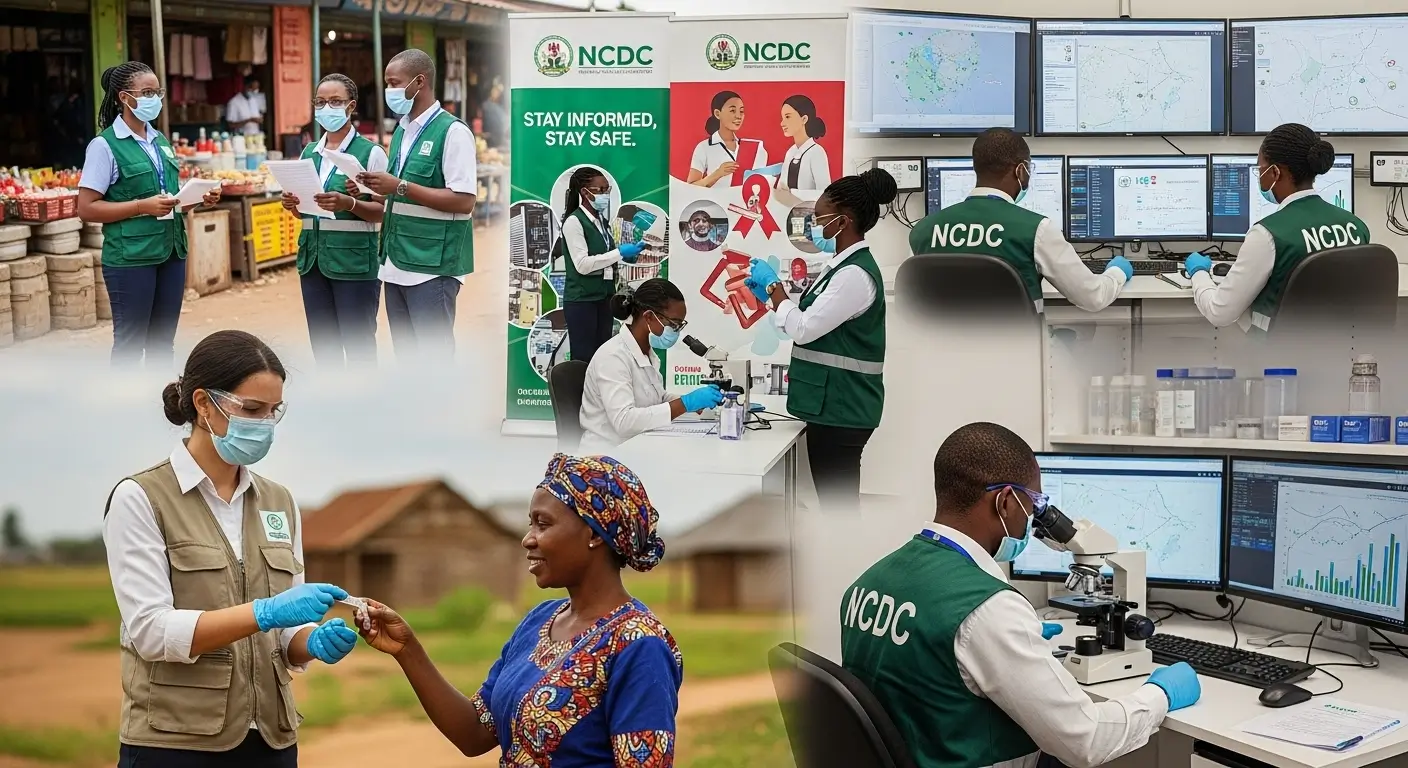
The Nigeria Centre for Disease Control (NCDC) is the country’s first line of defense through its rapid detection, prevention, and public health response to outbreaks initiatives.
National Centre for Disease Control Nigeria: The Frontline of Public Healt
National Centre for Disease Control Nigeria is the mainstay of the nation in maintaining wholesome health by controlling infectious diseases. The organization, established to reinstate health security, did not hesitate to perform the decisive action when the outbreaks disrupted communities anywhere in the country.
It is an on-going commitment which the agency makes, to monitor data, track disease trends, and dispatch teams from the NCDC (National Centre for Disease Control) in Nigeria to tackle issues like Lassa fever, cholera, and COVID19. The Nigerian Center for Disease Control and Prevention is mainly focused on being prepared before any incident gets out of hand, hospitals, labs, and public health workers thus must be furnished with the required tools.
They are not only involved in responding to the call of the crisis. The agency is keen on upgrading the healthcare system of the country by implementing monitoring systems, linking laboratories, and training programs. With connections to worldwide bodies including WHO and Africa CDC, they make sure that local health levels meet the best practice standards worldwide.
Nigeria Centre for Disease Control Act: The Legal Backbone
The Nigeria Centre for Disease Control (NCDC) Act provides the agency with the power to carry out its functions efficiently. The law, which was passed in 2018, formally recognized the NCDC as a legally independent national institution accountable for disease prevention, detection, and control.
The Act empowers the Nigeria Centre for Disease Control to lead such activities as outbreak investigations, the implementation of policies, and the enforcement of public health measures. The agency is also authorized to collect and manage epidemiological data and provide the government with expert advice on the best response strategies.
The NCDC through this Act was given the freedom to cut through bureaucratic delays and thus respond very quickly to emergencies without having to wait for going through the usual channels. In addition, the law provided the blueprint for the creation of the National Reference Laboratories and the National Public Health Emergency Operations Centre (EOC). These have become instrumental in the swift coordination of responses to the COVID19 and monkeypox epidemics, among others.
Furthermore, the Act mandates the involvement of communities and communication of risks. This equips the citizens with the right information on the necessary preventive measures and ensures that they are aware of the correct conduct in times of public health emergencies.
How the Nigeria Centre for Disease Control Protects Nigerians Daily
The Nigerian Center for Disease Control and Prevention operates under several key pillars:
1. Surveillance and Data Analytics
The NCDC uses realtime data collection tools such as the Integrated Disease Surveillance and Response (IDSR) system. This helps track patterns, identify new threats, and predict possible outbreaks before they spread widely.
2. Laboratory Capacity
Through a network of molecular laboratories nationwide, the agency conducts diagnostic testing and genome sequencing. This advanced capability allows for accurate identification of pathogens ensuring targeted treatments and vaccines.
3. Rapid Response Teams
When a suspected outbreak arises, specialized teams are dispatched to investigate, isolate, and contain the disease. These professionals work closely with local health departments and hospitals to provide immediate support.
4. Community Awareness
The NCDC’s communication strategies ensure that communities receive timely information. Public health campaigns on hygiene, vaccination, and disease prevention have reduced misinformation and increased compliance during crises.
5. Collaboration and Research
Working with universities, international health organizations, and private sectors, the NCDC conducts ongoing research on emerging infectious diseases. These studies influence policy decisions and improve Nigeria’s health systems overall.
Challenges and the Road Ahead
There are still a few problems in the way of the admirable accomplishments that have been made. The insufficiency of money, the gaps in the infrastructure, and the presence of misleading information sometimes create obstacles for the operations. Yet, the Nigeria Centre for Disease Control is constantly adapting its structure to the changes brought about by the digital age, betterment of the supply chain, and programs for the development of human capacity.
The public health system in Nigeria is a great challenge that, if met successfully, can be the future of the country. It requires a continuous inflow of resources and close cooperation among the federal, state, and community levels. The existence of the NCDC Act as a reliable source of governance and the National Centre for Disease Control Nigeria being at the forefront of the implementation make the country even more prepared to face public health crises than before.
FAQs
What is the main function of the Nigeria Centre for Disease Control?
Through surveillance, research, and emergency response coordination, it actively works to prevent, detect, and control infectious diseases.
When was the Nigeria Centre for Disease Control Act enacted?
The Act was signed into law in 2018, giving the NCDC the power and freedom to operate independently in situations of national health emergencies.
How does the Nigerian Center for Disease Control and Prevention collaborate internationally?
To ensure global health security, the organization collaborates with WHO, Africa CDC, and U.S. CDC to share research, surveillance data, and technical expertise.