

Ever finished a full course of antibiotics and still felt like rubbish? Yeah, quite maddening.
The bacteria didn’t fight fair. They adapted. Every mechanism of antimicrobial drug resistance is basically a bug learning to slip the punch, and these things have had billions of years of practice.
Here’s what people miss, though. Understanding antimicrobial resistance mechanisms matters to you, not just to scientists in white coats. It decides whether your next pill does anything at all. NNAST has been banging this drum for years.
How a Single Bug Beats a Drug
An antibiotic is a saboteur. It sneaks into the bacterium and jams something the cell can’t live without.
Resistance? That’s the bug learning to bar the door, switch the locks, or fling the saboteur back outside before it does real harm.
That is the entire war. And it plays out trillions of times a day, inside people, animals, soil, water, everywhere you look.
Bacteria are also quick. One splits into two roughly every twenty minutes, so a single lucky mutation can become a small army by dinner. Evolution on fast-forward, basically.
The Moves They Actually Pull
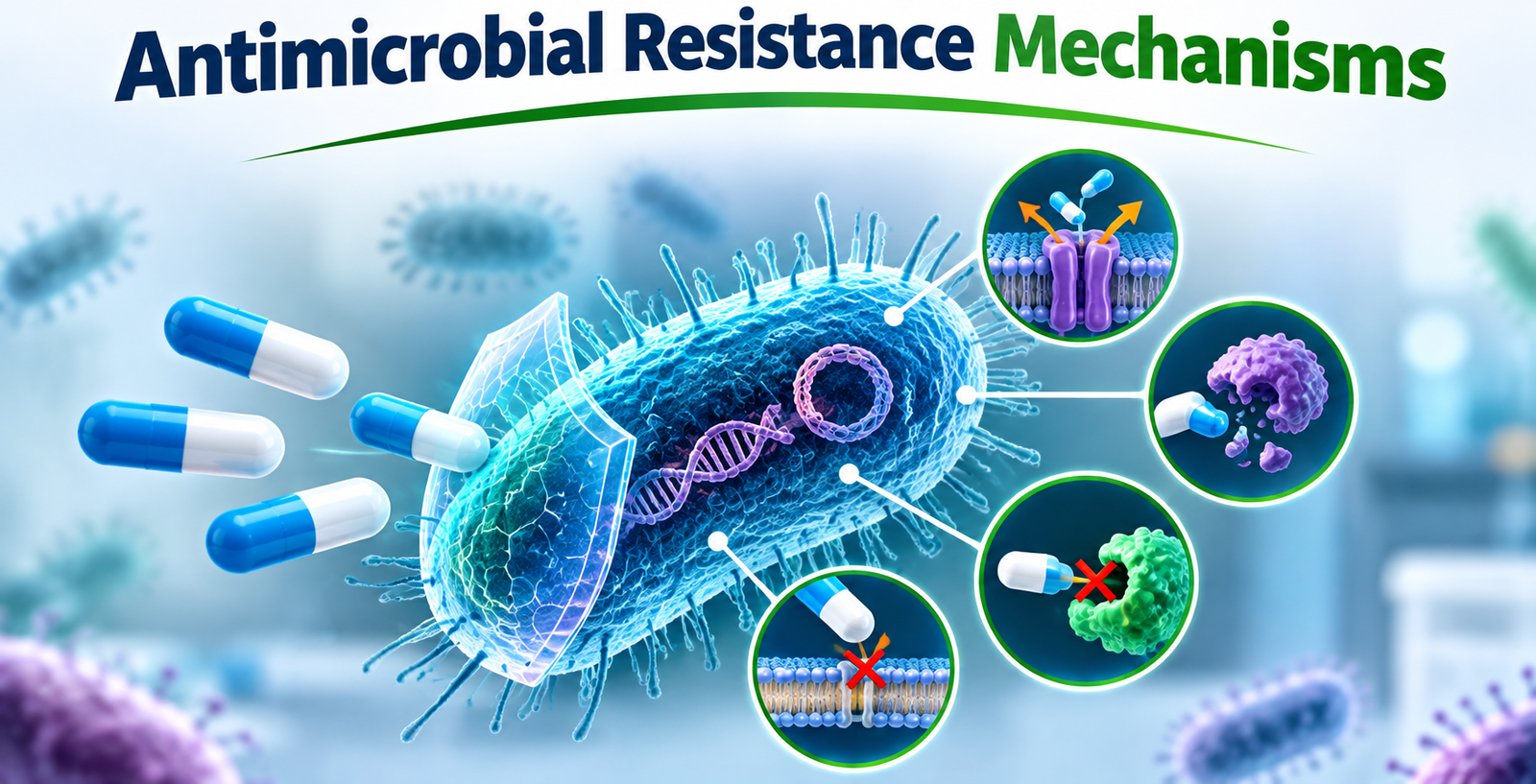
Let’s spare you the jargon where we can. Most antimicrobial resistance mechanisms boil down to four street-fighter tactics.
Break The Weapon
Some bugs spit out enzymes that snap the drug clean in half before it can land.
Beta-lactamases do this to penicillin and its whole family. The drug strolls in, gets shredded, and the cell doesn’t even flinch. Newer versions now chew through our emergency, last-line drugs too, which is the part that should scare you.
Switch The Lock
Others quietly redesign whatever the drug was aiming for. Right key. Wrong keyhole now.
MRSA is the poster child here. It swaps out one protein and a whole shelf of penicillins goes useless overnight. Then, for free, that trait copies itself into every new cell.
Show It The Door
This one almost makes us laugh, grimly. Efflux pumps just escort the drug straight back out. Bouncer energy.
Too little stays inside to cause trouble. And plenty of pumps aren’t picky, so one of them can boot out several different drugs at once.
Bolt The Front Gate
A handful simply shrink the tiny doorways in their outer wall, so barely any drug gets in. Quiet, unshowy, and brutally effective. Pair it with a pump, and the drug barely stands a chance.
When Bugs Start Trading Secrets
Now the part that truly rattles the experts. Bacteria don’t hoard these tricks.
One cell cracks a problem, copies the answer onto a little ring of DNA called a plasmid, and passes it to whoever’s next door. A totally different species? Doesn’t care one bit.
That handoff is why the mechanisms of bacterial resistance travel like gossip. Not slow inheritance. A live, cash-in-hand market in survival hacks.
Packed hospital wards and heavy antibiotic use are the busiest stalls in that market. Add poor sanitation and the trading only speeds up.
A Resistance Story You’ll Recognise
You’ve probably lived a version of this already. A stubborn urinary infection the usual tablet just won’t shift. A relative whose typhoid needed a second, stronger drug because the first did nothing.
That isn’t bad luck. That’s resistance, already sitting in your own community.
Gonorrhoea is the loud alarm. It has burned through nearly every drug we once trusted, and doctors now guard the last few options like gold. Miss those, and it turns untreatable.
Why anyone bothers tracking all this
You can’t outsmart an enemy you can’t even see. That, in one line, is the case for antimicrobial resistance surveillance.
Stripped of the fancy word, it just means labs keeping tabs on which drugs are quietly failing, in which towns, and how fast.
Catch a new trick while it’s still one outbreak, and you can box it in. Good antimicrobial resistance surveillance buys you that head start. Miss the window, and you’ll be chasing the thing for years.
It also tells nearby doctors which antimicrobial resistance mechanisms are already in play, so they pick a drug that still bites. Where that tracking runs thin, resistance gets a lead nobody can afford. Closing that exact gap is a lot of what NNAST does.
So Where Does That Actually Leave Us
Knowing the mechanisms of bacterial resistance isn’t the finish line. It’s just the map.
The real work is slowing them down. Finish your course. Don’t beg for antibiotics over a head cold. Back proper antimicrobial resistance surveillance so the next wave doesn’t catch anyone blind.
Every careful dose is one lesson we don’t hand to the bacteria. And that fight is worth caring about, because the mechanisms of bacterial resistance won’t stop evolving. So neither can we.