
Let’s be honest for a second. We built this mess ourselves.
Decades of swallowing antibiotics for every sniffle, dosing livestock, and quitting courses halfway have handed us a full-blown antibiotic resistance crisis. Bugs that once died in a day now shrug off our best drugs.
But hopeless? Not even close. The strongest solutions to antimicrobial resistance already exist, and a surprising number are things you can act on this week. NNAST works on precisely this, so let’s talk fixes.
How We Dug The Hole
There’s an obvious need for a quick bit of history, because it explains everything.
Antibiotics felt like pure magic in the 1940s, so they were sprayed everywhere. Human medicine, animal feed, fish ponds, and whatnot.
Every needless dose was another rep at the gym for bacteria. They bulked up. We got lazy. And now here we are, paying interest on that debt.
In several markets, you can still grab strong antibiotics off a table, no prescription, no questions asked. Convenient, yes. Also quietly disastrous.
None of it felt reckless at the time. Each shortcut made sense on its own. Stacked together over eighty years, though, they trained a whole generation of bacteria to fight back.
The Farms Nobody Wants To Mention
Here’s a piece most people skip right over. A massive share of the world’s antibiotics never touches a sick human at all. It goes straight into healthy animals.
Farmers use them to fatten poultry and cattle faster, and to stop disease tearing through crowded pens. Cheap today. Ruinous tomorrow.
Resistant bacteria breed on those farms, then travel to us through meat, runoff, and soil. So this was never purely a hospital problem. It lands on your dinner plate too.
The Fixes That Genuinely Work
There’s no single silver bullet, so stop looking for one. Real antimicrobial resistance solutions stack a pile of unglamorous changes on top of each other.
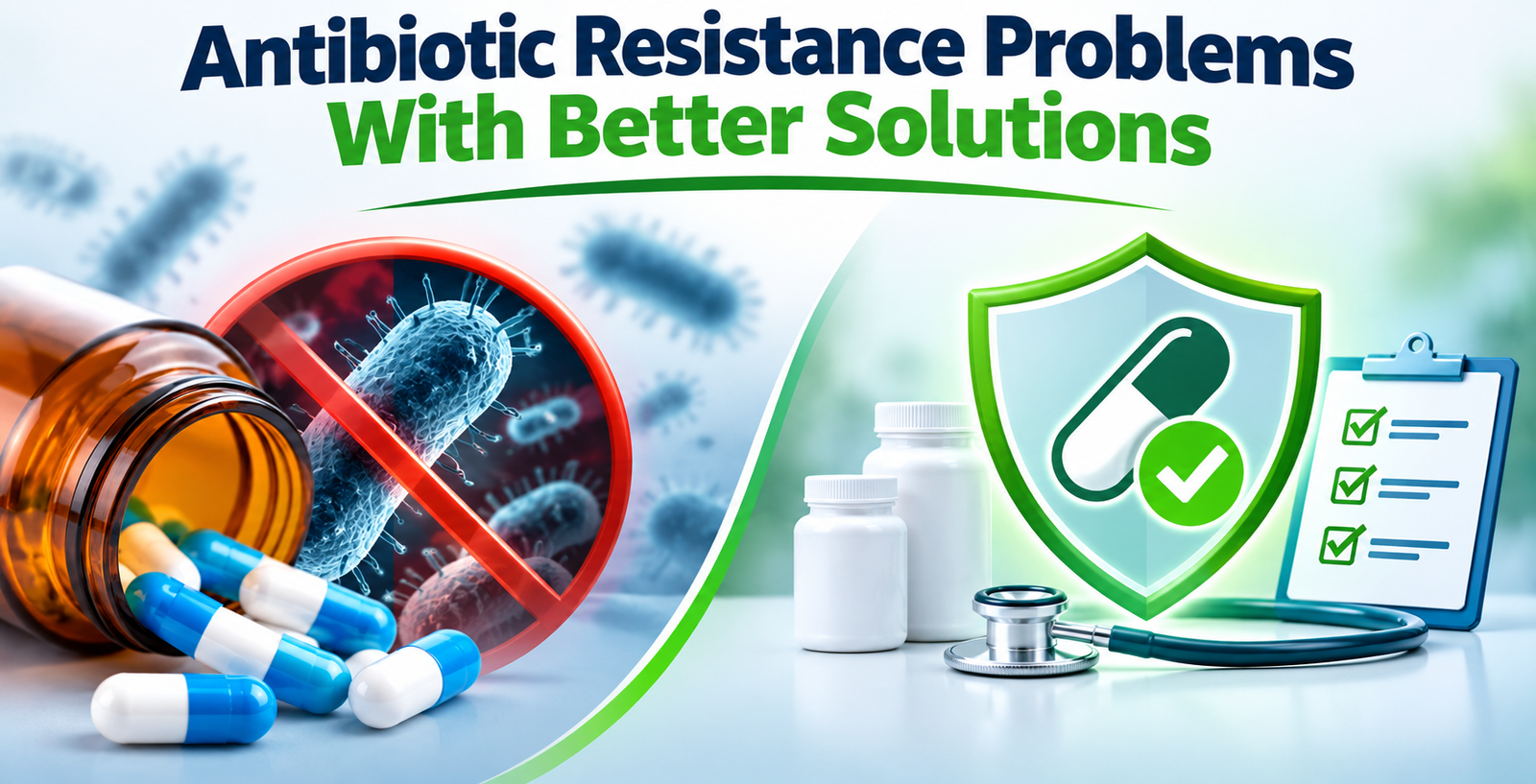
The trick is matching resistance problems with solutions, one stubborn problem at a time.
Use What We Already Have, Properly
Most of the win is just using today’s drugs the right way.
Right drug, right dose, full course, and not a single tablet beyond that. Hospital stewardship teams do this on purpose, and the results speak for themselves. Fewer wrong prescriptions, shorter courses where the evidence allows, and the drugs simply last longer for everyone.
Test First, Treat Second
Guesswork is half the disaster. A fast, cheap test that confirms you even need an antibiotic keeps the drug in reserve for when it truly counts.
Get diagnostics into local clinics, and you shift the whole picture, more than most policies ever could. Right now, far too many antibiotics get handed out for infections that were never bacterial in the first place.
Refill the Pipeline
We need fresh weapons too. New antibiotics, sure, but vaccines and plain old infection control pull just as much weight. An illness you prevent never needs a cure. The catch? Drug firms earn little from a pill you take for five days, so this part leans on public funding to move at all.
What You Can Actually Do
You don’t need a white coat to help here. Some of the sharpest antimicrobial resistance solutions start in your own kitchen drawer:
- Finish the full course, even when day three feels fine
- Don’t lean on your doctor for antibiotics over a cold
- Skip the off-the-shelf self-treating
- Toss old leftover tablets instead of passing them round the family
Tiny habits, we know. Multiply them across millions of people, though, and the needle genuinely moves. Call it herd behaviour, the good kind. Your restraint quietly protects the next person in the queue.
Where the bigger fight lives
Personal habits count. The heavy lifting, honestly, is national.
Coordinated solutions to antimicrobial resistance need government, farms, hospitals, and pharmacies rowing in the same direction. One weak link, and resistant bugs stroll straight through it.
That joined-up push is the whole point of NNAST, and it’s why serious solutions to antimicrobial resistance have to be system-wide, never just personal.
Nigeria’s national action plan leans on exactly this kind of teamwork, tying every weak spot to someone whose job is to fix it.
The Honest Bottom Line
Here’s the take without sugar-coating. We aren’t doomed, but we are absolutely on the clock.
Pairing resistance problems with solutions only works if we start now and refuse to drift. The science is ready. The antimicrobial resistance solutions are ready.
What’s missing is urgency, and that bit sits with all of us. Match enough resistance problems with solutions, and this crisis turns into a story we got to survive.
That’s the ending that’s needed. Not a miracle, just a lot of ordinary people choosing to act before the last drug quits on us.